
At F.E. Moran, we don’t just build HVAC systems—we design mechanical lifelines that shape city skylines.
When it comes to skyscrapers, every level introduces more complexity. More weight. More air. More pressure. And more opportunity to get it wrong—or to get it exactly right. That’s the story behind 110 N. Wacker, a 57-story, 1.5 million square foot Class A+ office tower in downtown Chicago—and a definitive showcase of what F.E. Moran brings to modern high-rise construction.
F.E. Moran was entrusted with a design-assist delivery for the tower’s HVAC systems. Our mission: deliver performance, efficiency, flexibility, and safety, all within a structure that would become one of the most visible and celebrated landmarks on the Chicago River.
We didn’t just meet the challenge. We set a new standard.
And the industry took notice: 110 N. Wacker was recognized with the “Commercial Development of the Year” award from the Chicago Commercial Real Estate Awards and the “Best Commercial Construction Over $50 Million” Merit Award from the Chicago Building Congress. (source)
In a building of this scale, airflow isn’t just about comfort—it’s a safety imperative. Air pressures vary floor by floor, and poorly calibrated systems can result in hot/cold zones, inefficient energy use, and even compromised fire safety. F.E. Moran engineered a system that ensures balanced pressure, stable temperature control, and life-safety responsiveness throughout the vertical stack.
Mechanical rooms in high-rises often consume valuable leasable space. At 110 N. Wacker, our team reimagined traditional system layouts to minimize this footprint. By reducing mechanical room space by nearly 50% on Levels 23 and 56, we directly increased rentable square footage for the client—creating a new layer of economic value through engineering.
Tight shaft and ceiling zones required a tailored approach. F.E. Moran worked side-by-side with manufacturers and fabrication teams to design a custom fan system and mechanical housing panels that met airflow, acoustical, and access demands—without compromising the building’s architectural integrity or spatial limitations.
At the heart of the building is an event-driven Building Automation System (BAS) that goes beyond temperature control. Our integrated BAS solution manages energy across multiple zones and tenant spaces with real-time responsiveness and forecasting. Rather than waiting for temperature swings, the system makes micro-adjustments that preserve comfort while maximizing efficiency. It’s smart, responsive, and built for the future of urban mechanical systems.
Executing complex rigging and system installation at height—amidst tight timelines, overlapping trades, and limited laydown areas—is no small feat. Our team sequenced every phase of work with precision, leveraging deep coordination across trades and a proactive, field-driven mindset.
We supported phased turnover sequences to maintain aggressive scheduling, ensuring tenant readiness while still meeting stringent commissioning protocols at multiple elevations. The logistical complexity was immense—and exactly the kind of challenge we were built for.
110 N. Wacker isn’t just an architectural icon—it’s a technical triumph. It embodies everything F.E. Moran stands for: complex problem solving, value creation through innovation, and an unwavering commitment to quality and safety.
This project proved that great HVAC isn’t invisible—it’s invaluable.
Where others see commodity systems, we see opportunities to engineer competitive advantage. Our performance at 110 N. Wacker highlights a few key differentiators:
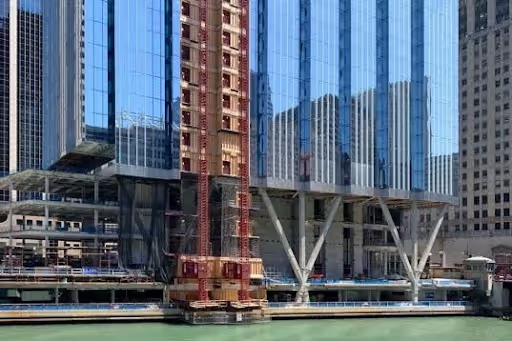
110 N. Wacker stands as a high-rise benchmark—not just for what’s possible, but for what’s next. With each floor we conditioned, each shaft we optimized, and each challenge we turned into an opportunity, F.E. Moran demonstrated what it means to lead in mechanical contracting.
Want to learn more about our high-rise HVAC expertise or how F.E. Moran can bring value to your next project?

